 shards.info
bindgen v0.9.0
Bindgen
Standalone C, C++, and/or Qt binding and wrapper generator.

Installation
Add the dependency to shard.yml:
dependencies:
  bindgen:
    github: Papierkorb/bindgen
    version: ~> 0.9.0
Table of Contents
The configuration keys are described in CONFIGURATION.md.
- How To
- Projects using bindgen
- Mapping behaviour
- Features
- Architecture of bindgen
- Processors
- Documentation comments
- Advanced configuration features
- Platform support
- Contributing
- License
How To
When you have a Crystal project and want to bind to C, C++, or Qt libraries with the help of bindgen, do as follows:
- Add bindgen to your project's
shard.ymlas instructed above under "Installation" and then runshards - Copy
lib/bindgen/assets/bindgen_helper.hppinto yourext/subdirectory, creating it if missing. Copy it again whenever you upgrade bindgen, as the generated code relies on the matching version - Copy
lib/bindgen/TEMPLATE.ymlintoyour_template.yml(adjust the name to your liking) and customize it for the library you want to bind to. Every key is described in CONFIGURATION.md - Run
lib/bindgen/tool.sh your_template.yml. This will generate the bindings, and by default place the outputs in theext/subdirectory - Develop your Crystal application as usual
Note: If you ship the output produced by bindgen along with your application, then bindgen will not be not required to compile it. In that case, you can move its entry in shard.yml from dependencies to development_dependencies.
The .yml file that you copy from TEMPLATE.yml will contain the complete configuration template along with accompanying documentation embedded in the comments. If you prefer working with shorter files, you can simply remove all the comments. CONFIGURATION.md describes the same keys as a reference.
Projects using bindgen
You can use the following projects' .yml files as a source of ideas or syntax for your own bindings:
Have you created and published a usable binding with bindgen? Want to see it here? Send a PR!
Mapping behaviour
The following rules are automatically applied to all bindings:
- Method names get underscored:
addWidget() -> #add_widget- Setter methods are rewritten:
setWindowTitle() -> #window_title= - Getter methods are rewritten:
getWindowTitle() -> #window_title - Bool getters are rewritten:
getAwesome() -> #awesome? isgetters are rewritten:isEmpty() -> #empty?hasgetters are rewritten:hasSpace() -> #has_space?
- Setter methods are rewritten:
- On signal methods (For Qt signals):
- Keep their name for the
emitversion:pressed() -> #pressed - Get an
on_prefix for the connect version:#on_pressed do .. end
- Keep their name for the
- Enum fields get title-cased if not already:
color0 -> Color0
Features
| Feature | Support |
|---|---|
| Automatic Crystal binding generation | YES |
| Automatic Crystal wrapper generation | YES |
| Mapping C++ classes | |
| +- Member methods | YES |
| +- Static methods | YES |
| +- Getters and setters for instance variables | YES |
| +- Getters and setters for static variables | YES |
| +- Constructors | YES |
| +- Copy constructors, assignment operators | YES |
| +- Overloaded operators | Partial |
| +- Conversion functions | YES |
| Mapping C/C++ global functions | |
| +- Mapping global functions | YES |
| +- Wrapping as Crystal class | YES |
| Overloaded methods (Also default arguments) | YES |
| C arrays in methods | |
+- References to arrays, as Slice |
YES |
+- Pointers to arrays, as StaticArray pointer |
YES |
+- Arrays of wrapped types, as ArrayView |
YES |
| Copying default argument values | |
| +- Integer, float, boolean types | YES |
| +- String | YES |
| Enumerations | YES |
| Copying structures | YES |
| +- C array members of built-in types | YES |
| +- C array members of wrapped types | TBD |
| +- Bit-fields | TBD |
| Custom type conversions between C/++ and Crystal | YES |
| Automatic type wrapping and conversion | YES |
| Integration with Crystals GC | YES |
| +- Keeping objects passed to C++ alive | YES |
| C++ Template instantiation for containers types | |
| +- Sequential containers | YES |
| +- Associative containers | YES |
| C++ class template instantiations | |
| +- Type and integral non-type arguments | YES |
| +- Default template arguments | YES |
+- Generic Crystal type (Box(T)) |
TBD |
| +- Automatic instantiation | TBD |
| Virtual methods | YES |
| Override virtual methods from Crystal | YES |
| Abstract classes | YES |
| Multiple inheritance wrapping | YES |
Downcasting polymorphic classes (#to?) |
YES |
| Qt integration | |
| +- QObject signals | YES |
| +- QFlags types | YES |
+- QMetaObject generation (mimic moc) |
TBD |
#define macro support |
|
| +- Mapping as enumeration | YES |
| +- Mapping as constant (Including strings) | YES |
| Copying in-source docs | YES |
| Platform specific type binding rules | YES |
| Portable path finding for headers, libs, etc. | YES |
Architecture of bindgen
Bindgen employs a pipeline-inspired code architecture, which is strikingly similar to what most compilers use.
The code flow is basically Parser::Runner to Graph::Builder to Processor::Runner to Generator::Runner.

The Graph
An important data structure used throughout the program is the graph. Code-wise, it's represented by Graph::Node and its sub-classes. The nodes can contain child nodes, making it a hierarchical structure.
This allows to represent (almost) arbitrary structures as defined by the user configuration.
Say we're wrapping GreetLib. As any library, it comes with a bunch of classes (Greeter and Listener), enums (Greetings, Type) and other stuff like constants (PORT). The configuration file could look like this:
module: GreetLib
classes: # We copy the structure of classes
  Greeter: Greeter
  Listener: Listener
enums: # But map the enums differently
  Type: Greeter::Type
  Greeter::Greetings: Greetings
Which will generate a graph looking like this:
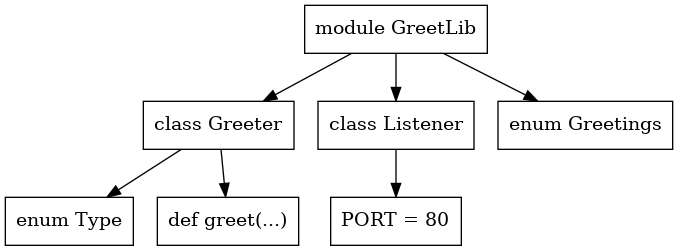
Note: The concept is really similar to ASTs used by compilers.
Parser step
This is the beginning of the actual execution pipeline. It calls out to the clang-based parser tool () to read the C/C++ source code and write a JSON-formatted "database" onto standard output. This is directly read by bindgen and subsequently parsed as Parser::Document.
Graph::Builder step
The second step takes the Parser::Document and transforms it into a Graph::Namespace. This step is where the user configuration mapping is used.
Processor step
The third step runs all configured processors in order. These work with the Graph and mostly add methods and Calls so they can be bound later. But they're allowed to do whatever they want really, which makes it a good place to add more complex rewriting rules if desired.
Processors are responsible for many core features of bindgen. The TEMPLATE.yml has an already set-up example pipeline.
Generator step
The final step now takes the finalized graph and writes the result into an output of one or more files. Generators do not change the graph in any way, and also don't build anything on their own. They only write to output.
Processors
The processor pipeline can be configured through the processors: array. Its elements are run in the order they're defined, starting at the first element.
Note: Don't worry: The TEMPLATE.yml file already comes with the recommended pipeline pre-configured.
There are three kinds of processors:
- Refining ones modify the graph in some way, without a dependency to a later generator.
- Generation processors add data to the graph so that the generators run later have all data they need to work.
- Information processors don't modify the graph, but do checks or print data onto the screen for debugging purposes.
The order in the configured pipeline is to have Refining processors first, Generation processors second. Information processors can be run at any time.
The following processors are available, in alphabetical order:
AutoContainerInstantiation
- Kind: Refining
- Run after: No specific dependency
- Run before:
InstantiateContainers
When encountering a known container class on an instantiation that is not registered yet, registers it.
Container classes still need to be declared in the configuration, but don't require an explicit instantiations attribute anymore:
containers: # At the top-level of the config
  - class: QList # Set the class name
    type: Sequential # And its type
    # instantiations: # Can be added, but doesn't need to be.
BlockOverloads
- Kind: Refining, but ran after generation processors!
- Run after:
CrystalWrapper,Qt - Run before: No specific dependency
Adds type parameters to ambiguous Crystal methods that take a single block argument, so that these methods can be overloaded by passing the parameter types of that argument to the method. Qt needs it for several signal connection methods.
cb = Qt::ComboBox.new
cb.on_activated(Int32) do |index| # Type argument added by this processor
  puts "Int32 overload selected: #{index}"
end
cb.on_activated(String) do |text| # Type argument added by this processor
  puts "String overload selected: #{text}"
end
CopyStructs
- Kind: Refining
- Run after: No specific dependency
- Run before: No specific dependency
Copies structures of those types, that have copy_structure: true set in the configuration, into lib Binding. Such a type is passed by value. It has to be layout-compatible to a C structure: Its members may only be built-in types, enumerations, other copied structures and pointers. A pointer to a type which is converted, like std::string *, becomes a Void*. bindgen refuses to copy a structure with a member it can't represent, like a std::string, a container or a class which isn't copied itself, and one whose C++ type isn't trivially copyable and standard-layout.
A wrapper class of a copy_structure type will host the structure directly (instead of a pointer) to it:
#to_unsafereturns a pointer to the hosted structure.- A structure received from C++ by value, reference or pointer is copied into a new wrapper instance. Changing it doesn't change the original.
- Property methods are generated for the members, see
InstanceProperties.
Set generate_wrapper: false and generate_binding: false to only get the lib struct.
CppWrapper
- Kind: Generation
- Run after: Refining processors
- Run before:
CrystalBinding
Generates the C++ wrapper method Calls.
CrystalBinding
- Kind: Generation
- Run after:
CppWrapper,VirtualOverrideandCrystalWrapper - Run before: No specific dependency
Generates the lib Binding funs.
CrystalWrapper
- Kind: Generation
- Run after: Refining processors
- Run before:
CrystalBindingandVirtualOverride
Generates the Crystal methods in the wrapper classes.
Objects kept alive for C++
Objects constructed from Crystal are allocated by the GC, which only sees pointers in memory it scans. If C++ code keeps a pointer to one elsewhere, like in a member of an object allocated with plain new, the GC collects it once the Crystal wrapper is gone, while C++ still uses it. With Qt, which keeps widgets added to layouts this way, this crashes in the GC's finalizers (Papierkorb/bindgen#75).
Configure the methods keeping a pointer to their arguments in keep_alive: of the class. Their wrapper methods pass the arguments, if they are wrapped objects passed by pointer or reference, to BindgenHelper.keep_alive. It stores the wrapper, which refers to the C++ object, until it's passed to BindgenHelper.release. BindgenHelper is part of the generated module.
Objects are kept by the address of their C++ object, as getters return a new wrapper each time: any wrapper of it, or its pointer, releases it. Nothing is released automatically, so an object C++ deletes stays in the table until released. If the library notifies of destruction, like Qt's QObject::destroyed, release it from there: .release may run in a GC finalizer.
types:
  QStatusBar:
    keep_alive: [^addWidget$, ^addPermanentWidget$, ^insert]
  Outer:
    keep_alive:
      ^inside$: true # The setter of the `inside` member
      ^$: [0]        # Only the first argument of constructors
label = Qt::Label.new("Ready")
status_bar.add_widget(label) # Keeps the label alive
status_bar.remove_widget(label)
Qt::BindgenHelper.release(label) # Lets the GC collect it again
See TEMPLATE.yml for details.
DefaultConstructor
- Kind: Refining
- Run after: No specific dependency
- Run before: No specific dependency
Clang doesn't expose default constructors methods for implicit default constructors. This processor finds these cases and adds an explicit constructor. Also, generates constructors for aggregate types.
DumpGraph
- Kind: Information
- Run after: Any time
- Run before: Any time
Debugging processor dumping the current graph onto STDERR.
Enums
- Kind: Refining
- Run after:
FunctionClass - Run before: No specific dependency
Adds the copied enums to the graph. Should be run after other processors adding classes, so that enums can be added into classes.
ExternC
- Kind: Refining
- Run after:
FunctionsandFunctionClass - Run before: No specific dependency
Checks if a method require a C/C++ wrapper. If not, marks the method to bind directly to the target method instead of writing a "trampoline" wrapper in C++.
Note: This processor is required for variadic functions to work. A variadic function looks like this: void func(int c, ...);
A method can be bound directly if all of these are true:
- It uses the C ABI (
extern "C") - No argument uses a
to_cppconverter - The return type doesn't use a
from_cppconverter
Note: If all methods can be bound to directly, you can remove the cpp generator completely from your configuration.
FilterMethods
- Kind: Refining
- Run after: No specific dependency
- Run before: No specific dependency
Removes all methods using an argument, or returning something, which is configured as ignore: true. Also removes methods that show up in the ignore_methods: list.
This processor can be run at any time in theory, but should be run as first part of the pipeline.
Functions
- Kind: Refining
- Run after:
FunctionClassandExternC - Run before: No specific dependency
Maps C functions, configured through the functions: map in the configuration.
FunctionClass
- Kind: Refining
- Run after:
ExternC - Run before:
InheritanceandFunctions
Generates wrapper classes from OOP-like C APIs, using guidance from the user through configuration in the functions: map.
Inheritance
- Kind: Refining
- Run after:
FunctionClass - Run before:
FilterMethodsandVirtualOverride
Implements Crystal wrapper inheritance and adds #as_X conversion methods. The Crystal superclass is the first wrapped base at offset 0 in the C++ class, the other bases are reached through #as_X, and their methods are wrapped in the derived class too. Also handles abstract classes in that it adds an Impl class, so code can return instances to the (otherwise) abstract class.
Adds #to?(T.class) casting methods, which also cast down between polymorphic classes through a dynamic_cast, returning nil if the object isn't a T: Bar.create.to?(Foo) # => Foo?. See SPEC.md §2.3.6. Downcasts use dynamic_cast: if the C++ code is built without RTTI (-fno-rtti, like Qt), one aborts the program instead.
InstanceProperties
- Kind: Refining
- Run after: No specific dependency
- Run before: No specific dependency
Generates getter and setter methods for static and instance members.
The members of an unnamed member of anonymous type are accessed as members of the enclosing class. A named member of anonymous type gets a wrapper class named after the type's position in the enclosing class, like Wrapped::Unnamed0 for the first anonymous struct or union in Wrapped, with property methods of its own. The getter returns a wrapper referring to the member inside the object instead of a copy. This pointer into the object keeps an object allocated by bindgen alive.
struct Wrapped {
  struct { int y; } z;
};
w = Wrapped.new
w.z.y = 5     # Changes `w`
w.z = other.z # Copies the member
As C++ code can't name the anonymous type, it is declared as typedef decltype(Wrapped::z) Wrapped_Unnamed0;. Static, const and pointer members of anonymous type are skipped, and so are members of anonymous type nested inside an unnamed member.
InstantiateContainers
- Kind: Refining
- Run after:
AutoContainerInstantiationif used - Run before: No specific dependency
Adds the container instantiation classes and wrappers.
Each container class also gets a generic module, e.g. QList(T). Use it as type restriction, or get the wrapper class of an instantiation through its of macro: QList.of(Int32).new. See SPEC.md for details.
Wrappers of sequential containers, like std::vector, are Indexable. Wrappers of associative containers, like std::map, std::unordered_map, QMap and QHash, offer a Hash-like interface: #[], #[]?, #[]=, #has_key?, #delete, #size, #keys, #values and #to_h, and they are Enumerable over tuples of the key and the value. #each iterates over a copy of the entries, so changing the container meanwhile is safe. Any Enumerable of such tuples, like a Hash, is accepted where C++ expects the container.
lengths = Std::Map.of(String, Int32).from({"one" => 3})
lengths["three"] = 5
lengths.each { |word, length| puts "#{word}: #{length}" }
Associative containers call the C++ methods count(key), erase(key) and size(), and the helpers bindgen_map_fetch, bindgen_map_store and BindgenMapEntries from bindgen_helper.hpp. For Qt, configure the method names:
containers:
  - class: std::map
    type: Associative
  - class: QMap
    type: Associative
    count_method: contains
    erase_method: remove
    insert_method: insert # Instead of `bindgen_map_store`, which needs `emplace`
Macros
- Kind: Refining
- Run after: No specific dependency
- Run before: No specific dependency
Maps #define macros into the graph. The mapping is configured by the user in the macros: list. Only value-macros ("object-like macros") are supported, function-like macros are silently skipped.
// Okay:
#define SOME_INT 1
#define SOME_STRING "Hello"
#define SOME_BOOL true

// Not mapped:
#define SOME_FUNCTION(x) (x + 1)
Operators
- Kind: Refining
- Run after: No specific dependency
- Run before: No specific dependency
Performs special handling for operator methods.
Operators are wrapped as methods named after them; those Crystal can't overload get a name, like operator= becoming #assign!. Conversion operators become #to_ and the type, like #to_bool for operator bool(). A copy constructor becomes an overload of .new taking the object to copy.
Qt
- Kind: Refining
- Run after: No specific dependency
- Run before:
BlockOverloads
Adds Qt specific behaviour:
- Removes the
qt_check_for_QGADGET_macrofake method. - Provides
#on_SIGNALsignal connection method. - Removes
#meta_object,#qt_metacast, and#qt_metacallfrom superclass wrappers, as these shouldn't be overridden by the user.
btn = Qt::PushButton.new
btn.on_clicked do |checked| # Generated by this processor
  puts "Checked: #{checked}"
end
SanityCheck
- Kind: Information
- Run after: Any time, as very last pipeline element is ideal.
- Run before: Any time
Does sanity checks on the graph, focusing on Crystal bindings and wrappers.
Checks are as follows:
- Name of enums, libs, structures, classes, modules and aliases are valid
- Name of constants are valid
- Name of methods are valid
- Enumerations have at least one constant
- Flag-enumerations don't have
AllnorNoneconstants - Crystal method overloads are unambiguous
- Method arguments and result types are reachable
- Variadic methods are directly bound
- Alias targets are reachable
- Class base-classes are reachable
- Structure fields are of a supported and reachable type
VirtualOverride
- Kind: Refining, but ran after generation processors!
- Run after:
CrystalWrapper! - Run before:
CrystalBindingandCppWrapper
Adds C++ and Crystal wrapper code to allow overriding C++ virtual methods from within Crystal. Requires the Inheritance processor.
Important Note: Make sure to run this processor after CrystalWrapper but before CrystalBinding.
It needs to modify the #initialize methods, and generate lib structures, bindings, and C++ code too.
This is the recommended processor order:
processors:
  # ...
  - crystal_wrapper
  - block_overloads
  - virtual_override
  - cpp_wrapper
  - crystal_binding
After this, usage is the same as with any method:
class MyAdder < VirtualCalculator
  # In C++: virtual int calculate(int a, int b) = 0;
  # In Crystal:
  def calculate(a, b) : Int32
    a + b
  end
end
Do NOT call super in the body of a Crystal method that overrides a concrete C++ virtual method! Due to Bindgen's limitations, doing so will result in a stack overflow immediately. Instead, Bindgen provides a private #superclass method in every concrete abstract class; it wraps the calling instance so that the original C++ methods can be called, bypassing Crystal's overrides.
class MyLogger < Calculator
  # In C++:
  # virtual void clear_memory();
  # virtual void add_memory(int m);

  # In Crystal:
  def clear_memory : Nil
    puts "M = 0"
    superclass.clear_memory
  end

  def add_memory(m) : Nil
    puts "M += #{m}"
    # unlike `super`, all arguments are mandatory
    superclass.add_memory(m)
  end
end
Documentation comments
Documentation comments in the C++ headers are copied into the generated Crystal wrapper, in front of the wrapped classes, methods, enums and module functions. The comments of a field are copied to its getter and setter. For a class template instantiation, the comments of the template are used.
/// A point on the screen.
struct Point {
  /** Moves the point by *dx* and *dy*.
   *  @param dx Horizontal distance. */
  void move(int dx, int dy);

  int x; ///< Horizontal position.
};
# A point on the screen.
class Point
  # Moves the point by *dx* and *dy*.
  # @param dx Horizontal distance.
  def move(dx : Int32, dy : Int32) : Void

  # Horizontal position.
  def x() : Int32
By default only documentation comments are copied: ///, //!, /** */ and /*! */, plus the trailing ///< form. Set all_comments: true under parser: to copy plain // and /* */ comments too. Clang ignores comments in system headers, which includes headers found through -isystem.
The comment text is copied as written, without the comment markers. Doxygen commands like @param and \brief aren't converted, and show up as is in the Crystal API documentation. Comments of enumerators and of #define macros aren't copied.
Advanced configuration features
Bindgen's YAML configuration files support conditional definitions as well as loading external dependency files.
Apart from that extra logic, the configuration file is still valid YAML.
Note: Conditionals and dependencies are only supported in YAML mappings (data structures equivalent to Hashes in Crystal). Any such syntax encountered in something other than a mapping will not trigger special behaviour.
Conditions
YAML documents can define conditional parts in mappings by having a conditional key with mapping value. If the condition matches, the mapping value will be transparently embedded. If it does not match, the value will be transparently skipped.
Condition keys look like if_X or elsif_X or else. X is the condition, and it looks like Y_is_Z or Y_match_Z. You can also use (one or more) spaces ( ) instead of exactly one underscore (_) to separate the words.
Available conditions:
Y_is_Z: true if the variable Y equals Z case-sensitively.Y_isnt_Z: true if the variable Y doesn't equal Z case-sensitively.Y_match_Z: true if the variable Y is matched by the regular expression inZ. The regular expression is created case-sensitively.Y_newer_or_Z: true when variable Y is newer or equals (>=) to Z. Variables are treated as versions.Y_older_or_Z: true when variable Y is older or equals (=<) to Z. Variables are treated as versions.
A condition block is opened by the first if. Later condition keys can use elsif or else (or if to open a new condition block).
Note: elsif or else without an if will raise an exception.
Their behaviour is like in Crystal: if starts a condition block, elsif starts an alternative condition block, and else is used if none of if or elsif matched. It's possible to mix condition key-values with normal key-values.
Note: Conditions can be used in every mapping, even in mappings of a conditional. Each mapping acts as its own scope.
Variables
Variables are set by the user of the class (probably through ConfigReader.from_yaml). All variable values are strings.
Variable names are case-sensitive. A missing variable will be treated as having an empty value ("").
Examples
foo: # A normal mapping
  bar: 1

# A condition: Matches if `platform` equals "arm".
if_platform_is_arm: # In Crystal: `if platform == "arm"`
  company: ARM et al

# You can mix in values between conditionals.  It won't "break" following
# elsif or else blocks.
not_a_condition: Hello

# An elsif: It matches if
# 1) the previous conditions didn't match, and
# 2) its own condition matches.
elsif_platform_match_x86: # In Crystal: `elsif platform =~ /x86/`
  company: Many different

# An else: Matches if all previous conditions didn't match.
else:
  company: No idea

# At any time, you can start a new if sequence.
"if today is friday": # You can use spaces instead of underscores too
  hooray: true
Dependencies
To modularize the configuration, you can require ("merge") external yaml files from within your configuration.
This is triggered by using a key named <<, and writing the file name as value: <<: my_dependency.yml. The file-extension can also be omitted: <<: my_dependency in which case an .yml extension is assumed.
The dependency path is relative to the currently processed YAML file.
You can also require multiple dependencies into the same mapping:
types:
  Something: true # You can mix dependencies with normal fields.
  <<: simple_types.yml
  <<: complex_types.yml
  <<: ignores.yml
The dependency will be embedded into the open mapping: It is transparent to the client code.
It's perfectly possible to mix conditionals with dependencies:
if_os_is_windows:
  <<: windows-specific.yml
Errors
An exception will be raised if any of the following occur:
- The maximum dependency depth of
10(MAX_DEPTH) is exceeded. - The dependency name contains a dot:
../foo.ymlwon't work. - The dependency name is absolute:
/foo/bar.ymlwon't work.
Platform support
| Arch | System | CI | Clang version |
|---|---|---|---|
| arm64 | macOS | GitHub Actions | Homebrew's latest |
| x86_64 | Arch Linux | GitHub Actions | Latest (shared) |
| x86_64 | Debian 12 | None | 14, 19, 22 |
| x86_64 | Ubuntu 24.04 | GitHub Actions | 14, 16, 18, 20, 22, 23 |
| Other systems | Help wanted | ? |
LLVM and Clang 14 or newer and Crystal 1.8 or newer are required.
You require the LLVM and Clang development libraries and headers. If you don't have them already installed, bindgen will tell you. These packages are usually named after the following pattern on Debian-based systems: clang-18 libclang-18-dev llvm-18 llvm-18-dev.
On macOS, install them with Homebrew: brew install llvm pcre2 bdw-gc. Homebrew's LLVM 23.1.0 can't be linked statically; run brew upgrade llvm to get a newer one, or set BINDGEN_DYNAMIC=1 to link the shared libraries.
Contributing
- Open a new issue on the project to discuss what you're going to do and possibly receive comments
- Read the
STYLEGUIDE.mdfor some tips. - Then do the rest, PR and all. You know the drill :)
Contributors
- Papierkorb Stefan Merettig - creator
- docelic Davor Ocelic
- kalinon Holden Omans
- HertzDevil Quinton Miller
- ZaWertun Yaroslav Sidlovsky
License
This project (bindgen) and all of its sources, except those otherwise noted, all fall under the GPLv3 license. You can find a copy of its complete license text in the LICENSE file.
The configuration used to generate code, and all code generated by this project, fall under the full copyright of the user of bindgen. bindgen does not claim any copyright, legal or otherwise, on your work. Established projects should define a license they want to use for the generated code and configuration.
bindgen

- 191
- 17
- 1
- 4
- 2
- 30 minutes ago
- August 22, 2017
GNU General Public License v3.0
Thu, 15 Oct 2026 21:54:37 GMT